I am looking forward to getting more insight about how older adults feel in regards to aging in place, SNF's, and CCRC's so I will have more compassionate and more patience If my career leads me in that direction. I am glad we had the opportunity to complete the aging quiz in class. I was surprised to find out more about aging in particularly that older adults do not find it any more difficult to adapt to change than someone my age would. I also thought it was interesting that physical handicaps were not the primary factors limiting the activites of older adults, rather ageism or stereotyping. Obviously, I have a lot to learn about the geriatric population and I look forward to doing so this semester.
Friday, May 25, 2012
A year in the making!
I can not believe the day has arrived that we can call ourselves "2nd years". It does have a nice ring to it though. But on to business. I must admit, this first week was a bit overwhelming. We are challenged now more than ever to "think like an OTA". Now is the 'application' portion of our education, which personally I believe is a challenge for me, but I am just going to hit the ground running and do my best.
I am looking forward to getting more insight about how older adults feel in regards to aging in place, SNF's, and CCRC's so I will have more compassionate and more patience If my career leads me in that direction. I am glad we had the opportunity to complete the aging quiz in class. I was surprised to find out more about aging in particularly that older adults do not find it any more difficult to adapt to change than someone my age would. I also thought it was interesting that physical handicaps were not the primary factors limiting the activites of older adults, rather ageism or stereotyping. Obviously, I have a lot to learn about the geriatric population and I look forward to doing so this semester.
One step closer 2B an OTA!
Already
this semester I have learned about a fascinating service provided to
residents at assisted living facilities through "ombudsman." Previously I
thought that it was a client's friends and family who stood behind them
in case they needed assistance, but who stands with those without
outside friends or family to help? According to the North Carolina Division of Aging and Adult Services:
"Long Term Care Ombudsmen serve as advocates for
residents in nursing homes and adult care homes (rest homes/assisted
living) throughout North Carolina. Ombudsmen receive and investigate
complaints made by or on behalf of long term care residents and work for
their resolution."
Finally, I can't seem to wrap my head around what Fieldwork will be like this semester Last semester we learned about all the physical and mental maladies that plague the elderly, and when you spend 5 months hearing what's wrong with the population it tends to color your opinions. I only know a few seniors on a personal level, and they are some of the most interesting people that I know, so I'm hoping that my time at Rose Manor will help paint a more complete picture of seniors for me.
So with that, let's start climbing that mountain and see what waits atop!
Rewarding new OTA Role: Citizen Advocate
This summer could be called "Everything you always wanted to know about Geriatrics in 10 weeks." I’m really excited about this semester because I
believe older adults are living links to history. They are so interesting. If I wonder what people were thinking/feeling
in 1945 when they heard a particular story, I can just ask them. That’s great!
It’s like turning on the History channel and getting “movies on demand.” And there are no commercials!!!
I’m a little bit nervous about transfers because of the risk
of falling. I know that a broken hip can
be lethal to an older adult. Twenty-four
percent of people with a hip fracture will die within the first year. (See http://www.nof.org/
) That statistic will scare any OTAS.
I’m also nervous about writing a SOAP note in 30 minutes or
less. I worry that it won’t be “quality”
work. I like to seriously think about
and “craft” my assignments. But, you
don’t always get to choose your working parameters like your patient, or the
amount of time you spend with them, or the amount of time you spend writing up
your notes. So I’ll just have to do the
best I can. I have a good friend that resolutely
says “It is, what it is.” I may adopt
that motto for this summer.
I’m really looking forward to seeing OTs work in an
environment that is devoted entirely to geriatrics. I want to see what types of activities they
come up with for people with different diagnoses. I hope the OTs are creative and have a big
“bag of tricks.”
I’m looking forward to getting to know some of the clients
and watching their health improve. I
witnessed that at my last fieldwork, and it felt so good to see the clients get
better. It was almost like observing a
miracle.
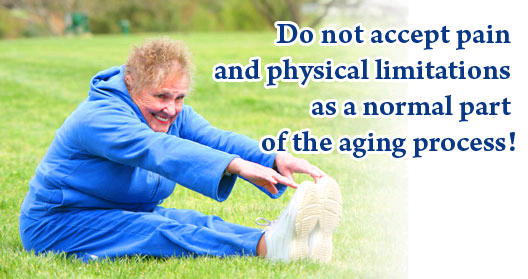
We covered a lot of myths/truths this week – some that I’d
heard before and some brand new. The two
myths that piqued my interest were “Physical handicaps are the primary factors
limiting the activities of older adults” and “Pain is a natural part of the
aging process.” Both of these statements
are false. The biggest detriment to the activities to
older adults is stereotyping and ageism.
(See http://ageismhurts.org/what-is-ageism
for more information on ageism.) Also,
pain is not normal; it’s an
indication of a problem and needs to be looked into. I believe that we, as OTAs, can educate society
(both young and old) about these misconceptions and, hopefully, improve the
lives of older adults. However, I
believe we’re going to have talk about this loudly and often in order to dispel
the myths.
Lastly, until hearing Carmelita Karhoff’s presentation, I really
didn’t know what an ombudsman was. Now I
know a bit better – they make sure that a resident’s rights are respected. (See http://www.tjcog.dst.nc.us/aging/ombudsmen.shtml
) I now know that there is a law
governing the rights of residents in adult care homes, i.e., Nursing Home
Reform Law of 1987 or “Omnibus Budget Reconciliation Act of 1987” (OBRA ’87.) See the AARP website http://www.aarp.org/home-garden/livable-communities/info-2001/the_1987_nursing_home_reform_act.html
for concise information about the law. The following is a quote from the website: The law was written to “ensure that residents
of nursing homes receive quality care that will result in their achieving or
maintaining their "highest practicable" physical, mental, and
psychosocial well-being.” Because of OBRA
’87 older adults no longer have to go to a nursing home to die. They can now go there to LIVE, and that’s a
change we can all celebrate.
CHERISH THE WISE
CHERISH THE
WISE…..
So….
I read the blog assignment, sit back for about 3 hours, closed my eyes, took a
deep breathe, and waited for some kind of magnificent, incredible thought to
enter my mind. The only thing that came
to mind was, “Pam, it’s going to be another semester of incredible information that
will benefit you and the welfare of your future clients”. When I came into this field, I always had the
mindset that I only want to work with children.
The more that I sit and think about aging the only thing that comes to
mind is that we all just become children all over again. We are born, our parents plants seeds and a
foundation, we make decisions about the course of our lives, we place our stamp
on world (good or bad) , we reflect about all the decisions that we make, then
we become fragile as a child, and dependent, and we pass our wisdom on to the
next generation. The only gap in this
scenario is that sometimes we miss that bridge of connecting to the next
generation because young people just do not make the time anymore for growth.
Being part of the “next generation” it makes you wander where will you be 50 or
60 years from now? Will I be capable of
passing on the same wisdom and history to my children that my mother and
grandmother gave me? Will I be alone in death or old age? Will I have someone that will be considerate
about my wants and needs, when I can’t achieve them alone and need help? Will I
impact other people lives for the good? As a student, I only worry about being
capable of providing the best therapy to each of my clients, and not getting
comfortable in the same activities. I don’t want my therapy sessions to become
a routine. I want my patients to be excited about their path to independence because
they will never know what to expect in therapy. I am eager about working with
the elderly because they never stop giving knowledge. The fact that they
continue to try is the most amazing thing to see. This week alone I was excited
to see that all my classmates were still here and we have some great COTA’s on
the way world. Also, I was surprised that the old is out living the younger
now. In my opinion, it’s because the
younger refuse or ignore direction, wisdom, and knowledge that is given by the
older. I now see how it is important to shape my future now more than
ever. When I look in the mirror at the
age of 75, I want to be content with myself and all that I have done, with no
regrets! So I end my thoughts with this
saying about aging…..
“Do
not regret growing older. It is a privilege denied to many”.
~Author
Unknown
Moving On in the Program
We are moving on to our second year--oh how the time has flown so far! I don't FEEL like a second year student although I can tell I have learned some things and retained some important information regarding occupational therapy and how it relates to function and wellness. I can see this in my ability to answer questions posed to me in class, and in the way I observed video taped treatment sessions this past week. I am starting to think like an OTA! This is exciting and although I should only speak for myself, I think my classmates are feeling the same--we have come through a demanding part of the program and will soon be reaping the benefits from our hard work. I am excited to be starting our geriatric fieldwork and wonder how it will compare to other experiences I have had with the elderly.
I honestly can't think of anything that daunts me today. I am sincerely excited to enter into the unknown of this part of our journey and I know our instructors have done their very best to prepare us for what lies ahead. I now appreciate the difficulty of last semester and realize the importance of feedback I have received from teachers and supervisors alike. I am truly excited about this semester even though I have no idea what to expect. Mostly I am looking forward to being on my own somewhat, to being faced with making observations and decisions about treatment, and to be working on documentation while under pressure. It's so important to me to go through this experience with confidence and open-mindedness. I want to welcome feedback from superiors, especially if it is negative because this is what will help me the most. I look forward to honest appraisals and to hopefully surprising myself with knowledge I wasn't sure I had! I also am looking forward to being at fieldwork alongside my classmates, and hope to be a source of encouragement to them as they will be to me.
This week I have learned that I am more ready for this opportunity than I thought I was. Just hearing from our teachers about what to expect has gotten me really excited because it will be so different from anything we've done so far. Going over some facts about aging trends was another thing that stuck out to me and I was interested to hear that soon the number of people 65 and older will be HIGHER than the number of children age 5 and under. This has never been the case in all of recorded human history and speaks volumes to the changes that have occurred in lifestyles and health care. It also shows reason why many more changes need to occur in today's health care so that this ever-growing population can continue to thrive. I'm looking forward to being a part of that change--for the better!
Thursday, May 24, 2012
2nd Year!!
I can’t believe that we are already 2nd year students
and ready to tackle many more challenges! I am very interested and look forward
to learning more about the geriatric population. Since I currently work in a
SNF, and plan on doing so when I’m officially an OTA, it will be exciting to
learn more about these folks and be able to implement what we have already
learned in our previous classes.
As far as what daunts me…the answer to that would be
documentation. QUICK documentation. It’s one thing to sit down for an hour and
write a SOAP note, but being able to do it on the spot and in a short time
frame is something else. I already have “documentation performance anxiety”. <---
Nope, it’s not in the DSM :) Anyway, I know that with practice it will get
easier and I'm definitely up for the challenge. Practice makes perfect right?
Man I hope so!
One thing that I'm excited about is the interviews. It will be
interesting to hear the differences between answers and opinions of
people at different points in their lives. These folks have lived a long time
and have seen a lot of things in their lives and some of them love to share their
stories. Hopefully we will hear some good ones!!
And a video just for fun...
Tuesday, May 1, 2012
let's do away with labels!
Apparently the writers of the DSM-V
are not believers of the quote “an individual is not their diagnosis”. According to the national alliance on mental
illness (NAMI), “mental illnesses are medical conditions that disrupt a person’s
thinking, feeling, mood, ability to relation to other and daily functioning”. Asperger's syndrome is a developmental
disorder that affects a person's social and communication skills as with others as per mayo clinic, however most
individuals with Aspergers syndrome are
able to work successfully in mainstream jobs, although they may need continued
encouragement and moral support to maintain an independent life.
According to the article by the Mayo Clinic
on Asperger’s syndrome it is an autism
spectrum disorder, although previously it was classified as its own diagnosis
in the DSM-IV-TR the proposal for the DSM-V is to reduce the various
autism-like disorders, including Asperger’s syndrome, to a single diagnostic category
for the disorders. As explained in the
Huffington Post article on the proposed changes, those individuals who have
Asperger’s syndrome and are functionally living independent would rather not be
labeled autistic. With this label, may
come stigmas and prejudices’ that could possibly have been avoided. Being that one of the biggest symptoms of
individuals with AS is their socialization skills, this may compound the
problem and force them to socially withdraw even more. It
just seems that this proposal is taking 2 steps backwards in our efforts to
fight mental illness stigmas. Hopefully with enough upheaval this proposed
change will not be made permanent.
Here are a my resources:
Subscribe to:
Comments (Atom)

